
Creative Mode
A blank notebook.
Open to an empty page. Your child writes whatever’s on their mind: a story they’re inventing, a feeling, a question. Sit beside them and prompt “what happens next?” Rumo draws what they write, instantly.
Write. Reflect. Grow.
How it works
Your child grabs an Apple Pencil and writes a word, a sentence, or whatever's on their mind.
Your child grabs an Apple Pencil and writes a word, a sentence, or whatever's on their mind.
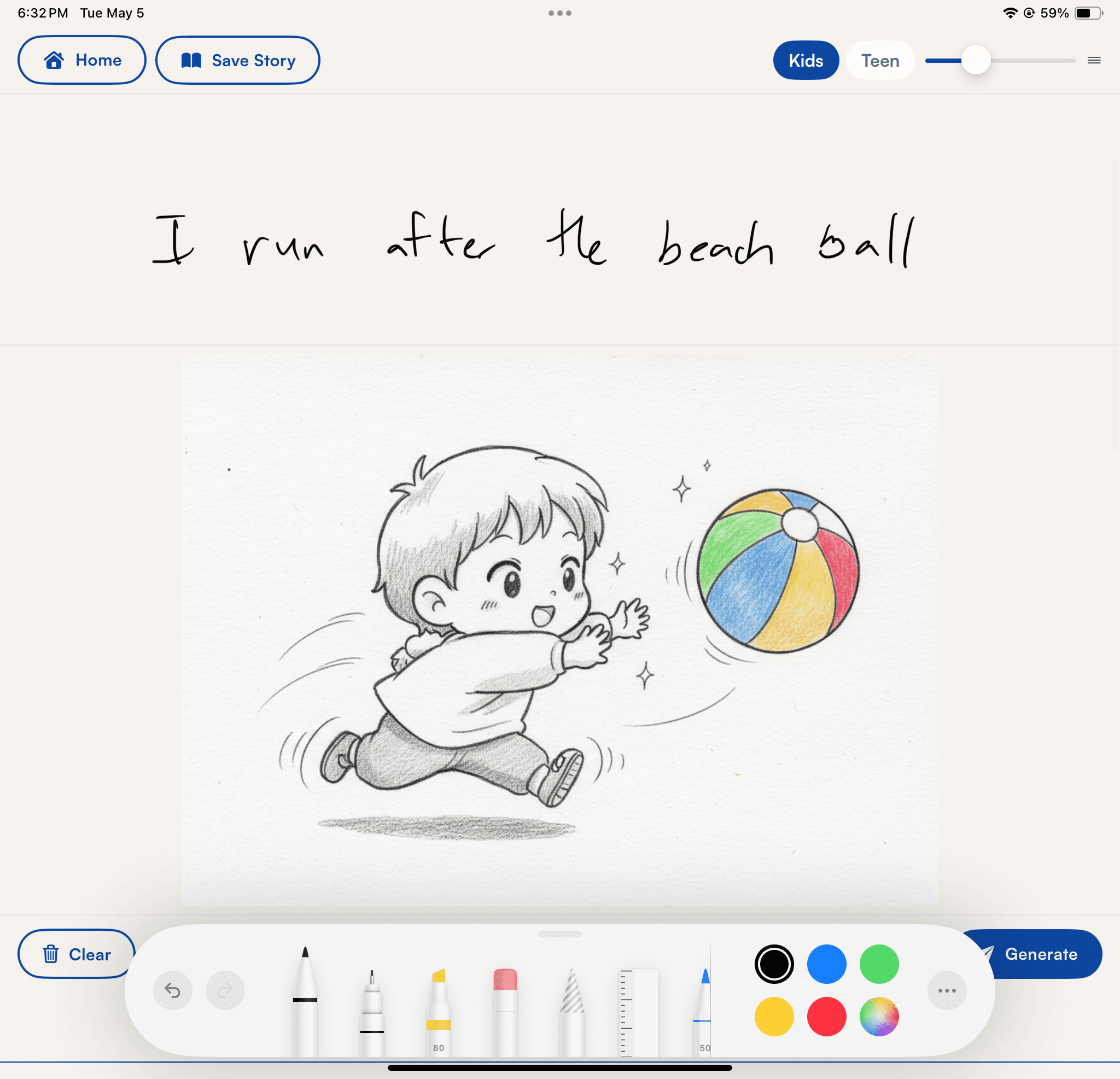
Rumo reads what they wrote and turns it into a picture. “I run after the beach ball” sprouts a tiny runner chasing a beach ball.
Choose from standard word lists like Dolch, Tier2, or custom word lists. The default word list is 900 words that cover more than 90% of what children read and write in school.
Inside the kid app
Rumo opens to a single notebook with two ways to use it. Creative Mode is a blank page where your child writes whatever’s on their mind. Learning Mode walks them through short, grade-appropriate lessons, one at a time.
Creative Mode
Open to an empty page. Your child writes whatever’s on their mind: a story they’re inventing, a feeling, a question. Sit beside them and prompt “what happens next?” Rumo draws what they write, instantly.
Learning Mode
Short modules from 1st through 5th grade, each tuned to age-appropriate sight words and sentence structures. Kids work through one lesson at a time and the notebook fills up as they go.
Why writing
Rumo is built around one idea: write every day and become a better reader. Comprehend the meaning of words with deliberative practice.
Read more →The Rumo difference
The country that asks 1st graders to write the most also reads the best.
Figure · 1st-grade writing time, weekly
In 1st grade, Japan spends roughly 18× more time writing than the US.
Theory & research
Built for both sides of the desk
For families
For schools
Team
Founder
MIT engineer, Stanford d.school designer, built Rumo for his niece on the conviction that language is learned by using it.
Advisor
One of the field’s leading voices on bilingual education and language as social practice.
Advisor
Researcher and author on bilingual sign language acquisition and literacy for Deaf and Hard of Hearing learners.
Questions
Rumo is built for kids from kindergarten through 12th grade, prompts adapt to each child's age and level, with a special focus on children with dyslexia and dysgraphia as well as Deaf and hard-of-hearing learners that phonics-first methods leave behind.
Five to fifteen minutes a day. The habit matters more than the length.
Yes. No ads, no public profiles, COPPA- and FERPA-aligned. Family and school dashboards keep adults in the loop.
Yes. One household covers up to 4 children, each with their own profile, and the parent dashboard shows every child's reading and writing history.
Yes. Every family starts with a 7-day free trial. After that Rumo is $14.99 a month for up to 4 children, and you can cancel anytime.
Unlock your kid's imagination.
Built for learnersDesigned for growthTrusted by schools & families



From the field
Students at a homeschool pilot wrote 1,000 sentences in just one hour.